
Table of Contents
Quick Summary
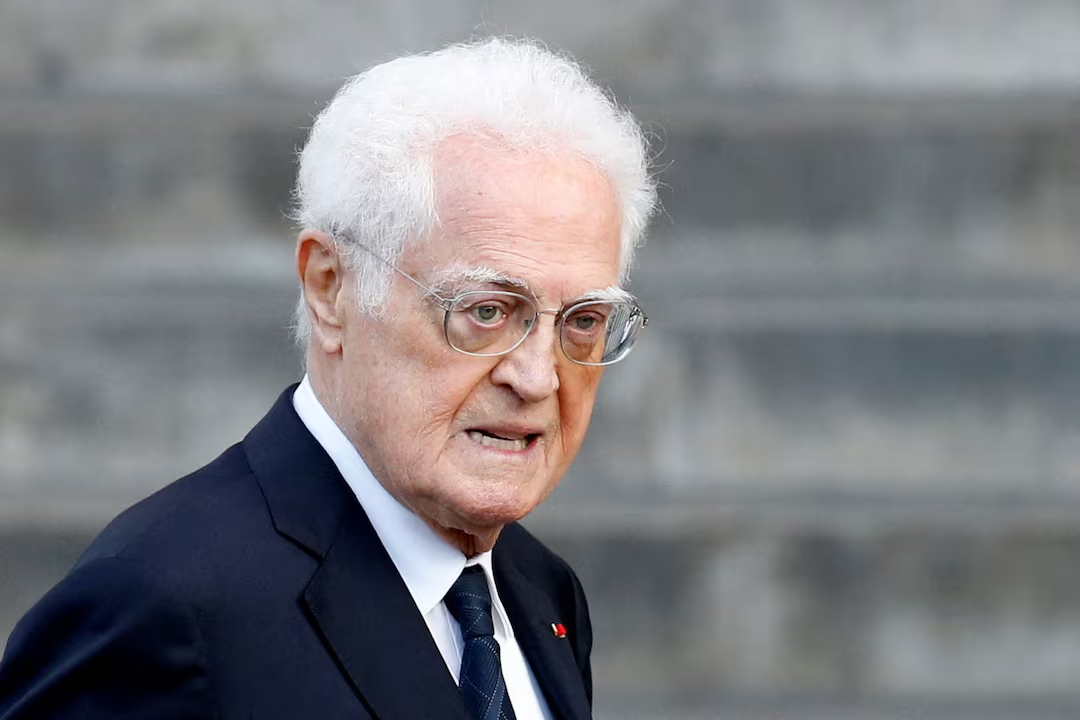
Lionel Jospin Dies at 88, marking the passing of one of France’s most influential political figures of the late 20th century. The news was confirmed by sources within the Socialist Party on March 23, 2026.
The former prime minister, who once came close to becoming president, is remembered for both his reformist policies and his unexpected defeat in the 2002 election.
Background
Lionel Jospin Dies at 88, bringing renewed attention to a defining moment in French politics — the shock outcome of the 2002 French presidential election.
At that time, Jospin was widely expected to advance to the final round. Instead, far-right leader Jean-Marie Le Pen edged ahead, eliminating Jospin in the first round. The result reshaped France’s political landscape and marked a turning point for the left.
Jospin’s withdrawal from politics immediately after that defeat symbolized a rare moment of accountability in modern leadership. His exit left a gap in the Socialist movement and changed the trajectory of future elections.
Details
Lionel Jospin Dies at 88 after a long career that spanned decades in public service. Born in 1937, he rose through the ranks of the Socialist Party and became a key ally of François Mitterrand.
He served as France’s prime minister from 1997 to 2002 under President Jacques Chirac. During his tenure, Jospin introduced several reforms that shaped modern France:
- Reduction of the working week from 39 to 35 hours
- Expansion of healthcare access
- Introduction of civil unions for both same-sex and heterosexual couples
- Creation of public-sector jobs aimed at reducing unemployment
Despite his socialist roots, Jospin also embraced economic liberalization. He oversaw privatization of major state-owned enterprises and supported France’s entry into the eurozone.
His political philosophy was often summarized by the phrase: “Yes to the market economy, no to a market society.” This reflected his attempt to balance economic growth with social welfare.
The defining moment of his career came in 2002 when he secured 16.18% of the vote, narrowly trailing Jean-Marie Le Pen’s 16.86%. That result prevented him from advancing to the runoff, which was ultimately won by Jacques Chirac.
After leaving office, Jospin remained largely out of frontline politics but continued to influence public life. In 2012, he was appointed by François Hollande to lead a commission on ethics in public governance.
Analysis
Lionel Jospin Dies at 88, prompting reflection on a political career defined by discipline, reform, and missed opportunity. His leadership style, often described as austere, contrasted sharply with more charismatic figures in French politics.
From a policy perspective, his tenure delivered tangible results. Economic growth improved, unemployment declined, and social protections expanded. Yet, his inability to unify the left in 2002 proved decisive.
Critics argue that his technocratic approach failed to connect emotionally with voters. Supporters, however, point to his integrity and commitment to principles as defining strengths.
The 2002 election remains a case study in political fragmentation. Multiple left-wing candidates diluted the vote, allowing the far right to advance. Jospin himself later acknowledged that underestimating this division contributed to his defeat.
His legacy is therefore complex. He is remembered both as a reformer who modernized France and as a candidate who fell short at a crucial moment.
What Next
Lionel Jospin Dies at 88, and France is expected to honor his legacy through tributes from political leaders across the spectrum. Discussions around his impact on labor laws, economic policy, and democratic values are likely to resurface.
Historians and political analysts may revisit his policies to assess their long-term influence on France’s economy and governance. Meanwhile, his role in shaping the careers of future leaders ensures that his influence will continue beyond his lifetime.
Lionel Jospin Dies at 88, closing a chapter in French political history marked by reform, discipline, and dramatic electoral change. His story remains a reminder of how quickly political fortunes can shift.

