
Table of Contents
Israeli strikes in central Beirut were reported early Wednesday after several air raids hit residential buildings in the Lebanese capital. Lebanese health authorities confirmed that at least six people died while more than twenty others suffered injuries following the explosions.
Air raid activity shook several districts of the city during the night as Israel intensified its military campaign against Hezbollah positions across Lebanon.
Residents described powerful blasts that lit up the sky while emergency responders rushed toward damaged buildings in the affected areas.
Quick Summary of Israeli Strikes in Central Beirut
What Happened
The Israeli strikes in central Beirut occurred during overnight air raids targeting multiple locations in the Lebanese capital.
Officials from the Lebanese health ministry confirmed that six individuals were killed and at least twenty-four others were injured in attacks that struck residential buildings.
Israeli military sources stated that some strikes were aimed at locations believed to be connected to Hezbollah.
Background of Israeli Strikes in Central Beirut
Regional Conflict Escalation
The Israeli strikes in central Beirut are part of the broader regional conflict involving Israel, Hezbollah, and Iran-aligned forces across the Middle East.
Hostilities escalated after Hezbollah joined the regional war in early March in support of Tehran. Since that point, Israeli forces have carried out numerous air raids targeting locations believed to be linked to the group.
Most of the earlier attacks focused on southern suburbs of Beirut where Hezbollah maintains a strong presence.
However, the latest strikes extended deeper into central districts of the Lebanese capital.
This shift has raised concerns among residents and officials regarding the growing scope of the conflict.
Impact on Civilians
Urban areas have increasingly felt the effects of military operations.
Civilian infrastructure sometimes becomes vulnerable when military targets are located in densely populated districts.
Because central Beirut contains residential neighborhoods and commercial centers, attacks in this area often cause significant disruption to daily life.
The Israeli strikes in central Beirut therefore intensified fears among residents already coping with weeks of regional tension.
Details of Israeli Strikes in Central Beirut
Locations of the Attacks
Authorities reported that the Israeli strikes in central Beirut targeted several neighborhoods during the overnight operations.
One strike occurred around 1:30 a.m. in the Zuqaq al-Blat district. The blast destroyed multiple floors of a residential apartment building and caused extensive structural damage.
Another explosion struck the nearby Basta neighborhood. At least two floors of a building collapsed following the impact.
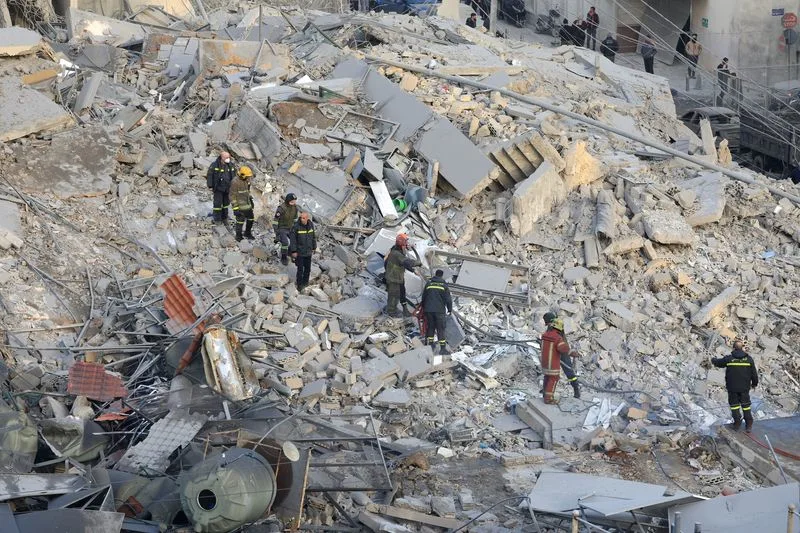
Later in the morning, around 5:30 a.m., a more powerful air raid destroyed an entire building in the Bachoura district.
Emergency crews immediately began searching the debris for survivors.
Casualties and Injuries
Officials from Lebanon’s health ministry confirmed that six people died following the Israeli strikes in central Beirut.
Medical teams transported injured individuals to nearby hospitals where doctors provided treatment.
At least twenty-four people sustained injuries during the attacks.
Rescue workers continued operations throughout the morning while authorities assessed the full extent of the damage.
Casualty numbers may change as additional information becomes available.
Israeli Warning Before One Strike
Prior to the strike in Bachoura, the Israeli military released a public warning through social media.
The message identified a specific building that Israel claimed was connected to Hezbollah operations.
Authorities urged residents to evacuate the area before the strike occurred.
However, no warning was issued ahead of the earlier Israeli strikes in central Beirut that affected the Zuqaq al-Blat and Basta districts.
Lebanese officials reported that casualties occurred primarily during those earlier explosions.
Damage to Infrastructure
Buildings across several neighborhoods suffered serious structural damage after the Israeli strikes in central Beirut.
Photographs from the scene showed collapsed floors, shattered windows, and debris scattered across nearby streets.
Emergency vehicles and rescue teams filled the affected districts as authorities worked to secure the area.
Electricity lines and nearby infrastructure also experienced disruptions due to the blasts.
Analysis of Israeli Strikes in Central Beirut
Strategic Implications
Military analysts say the Israeli strikes in central Beirut demonstrate a widening operational focus within the ongoing conflict.
Previous Israeli air operations largely concentrated on southern suburbs where Hezbollah maintains major facilities.
Expanding attacks into central neighborhoods may indicate efforts to target additional locations believed to be connected to the group.
Such actions also send a strong signal regarding Israel’s military strategy during the conflict.
Observers note that urban operations often increase the risk of civilian casualties.
Humanitarian Concerns
The Israeli strikes in central Beirut have raised humanitarian concerns due to the dense population of the targeted districts.
Many residents in the capital have already faced displacement as the conflict expanded.
Lebanese authorities estimate that more than one million people across the country have been forced to leave their homes since hostilities escalated earlier in the month.
Emergency organizations continue monitoring conditions in affected communities.
Support services may be required for individuals displaced by the destruction of residential buildings.
Political Reactions
Government officials in Lebanon have condemned the Israeli strikes in central Beirut, describing them as attacks that threaten civilian safety.
Meanwhile, Israeli authorities maintain that operations are directed at military targets connected to Hezbollah.
International observers continue urging restraint and diplomatic efforts to prevent further escalation.
Diplomatic discussions among regional and global powers may influence the direction of the conflict in the coming weeks.
What Next After Israeli Strikes in Central Beirut
Continued Military Operations
Military activity across Lebanon appears likely to continue in the near term.
Israeli forces have carried out additional air raids in southern and eastern parts of the country where Hezbollah maintains influence.
Reports indicate that airstrikes in the city of Baalbeck resulted in additional casualties.
Meanwhile, several southern towns also experienced bombardments as the conflict expanded beyond Beirut.
The Israeli strikes in central Beirut therefore represent only one part of a wider military campaign unfolding across multiple regions.
Humanitarian Response
Relief organizations may increase efforts to support communities affected by the Israeli strikes in central Beirut.
Medical teams, rescue workers, and humanitarian groups are already providing assistance to injured individuals and displaced families.
Authorities continue evaluating the damage to determine whether additional emergency measures are necessary.
Local government officials are expected to coordinate with international organizations to address humanitarian needs.
Broader Regional Context
Escalating Middle East Tensions
The Israeli strikes in central Beirut highlight the broader tensions currently affecting the Middle East.
The conflict involving Israel, Hezbollah, and Iran-aligned forces has expanded across several countries in the region.
Military activity now includes air raids, rocket launches, and drone strikes across multiple fronts.
Observers warn that continued escalation could lead to wider regional instability.
Diplomatic negotiations may therefore become increasingly important.
Impact on Lebanese Society
Residents of Beirut have endured repeated periods of conflict over the decades.
Many communities now face renewed uncertainty following the Israeli strikes in central Beirut.
Daily life in affected neighborhoods has been disrupted as emergency crews continue their work.
Families in damaged buildings may require relocation while repairs are carried out.
The psychological impact of overnight explosions also remains significant for local residents.
The Israeli strikes in central Beirut have left several people dead and many others injured after overnight air raids targeted buildings in multiple districts of the Lebanese capital.
Authorities confirmed that rescue operations and investigations are continuing as emergency crews assess damage and assist victims.
The strikes form part of a broader regional conflict that has already displaced large numbers of civilians and caused significant destruction across Lebanon.
International attention now focuses on whether diplomatic efforts may help prevent further escalation.

