
Table of Contents
Israel strikes Beirut once again, marking the first direct attack on the Lebanese capital since a fragile ceasefire agreement with Hezbollah was reached last month. The renewed military action has intensified fears across the Middle East, with analysts warning that the situation could spiral into a broader regional conflict involving Iran, Hezbollah, and Israel.
The strike targeted Beirut’s southern suburbs, an area widely known as a Hezbollah stronghold. Israeli officials confirmed the operation and claimed that the intended target was a senior commander from Hezbollah’s elite Radwan force. Reports from Israeli media suggested the commander may have been killed, although Hezbollah had not immediately confirmed the claim.
The attack immediately drew global attention because the ceasefire had been viewed as a critical step toward stabilizing tensions between Israel and Hezbollah after months of cross-border violence. Many international observers now fear the truce could collapse entirely.
Read: Trump press dinner attack suspect update security concerns
Why Israel Strikes Beirut Matters
The decision by Israel to launch airstrikes inside Beirut carries major political and military significance. The Lebanese capital has historically been one of the most sensitive locations in the long-running conflict between Israel and Hezbollah.
A strike in Beirut sends several messages:
- Israel is prepared to expand military operations beyond southern Lebanon
- Hezbollah leadership remains under direct threat
- The ceasefire agreement is increasingly fragile
- Diplomatic efforts between Lebanon and Israel face serious setbacks
Military analysts say the strike represents a dangerous escalation because attacks on Beirut often trigger stronger retaliatory responses from Hezbollah.
Background of the Israel-Hezbollah Ceasefire
The ceasefire between Israel and Hezbollah was brokered after weeks of escalating violence along the Israel-Lebanon border. The conflict intensified after Hezbollah launched attacks in support of Iran during rising regional tensions earlier this year.
Several international powers, including the United States and France, pushed aggressively for calm. Washington viewed the ceasefire as a critical part of broader negotiations involving Iran and Israel.
Although the agreement reduced large-scale attacks, violations continued in southern Lebanon. Israeli forces maintained positions south of the Litani River, while Hezbollah fighters reportedly continued drone and rocket operations targeting Israeli troops.
Because of these unresolved military activities, experts warned from the beginning that the ceasefire remained extremely vulnerable.
Israel Says Strike Targeted Hezbollah Commander
Israeli Prime Minister Benjamin Netanyahu and Defense Minister Israel Katz announced the operation in a joint statement.
According to Israeli officials, the strike specifically targeted a commander from Hezbollah’s Radwan force, an elite military unit responsible for cross-border operations and advanced combat missions.
Israeli intelligence agencies have repeatedly accused the Radwan force of planning attacks against northern Israeli communities. The military believes eliminating senior commanders weakens Hezbollah’s operational capabilities.
Security experts say targeted strikes like this are designed to disrupt Hezbollah leadership while sending a deterrent message to Iran-backed groups across the region.
Beirut Residents Fear Renewed War
The airstrike caused panic in southern Beirut, where residents had only recently begun returning to normal life after months of instability.
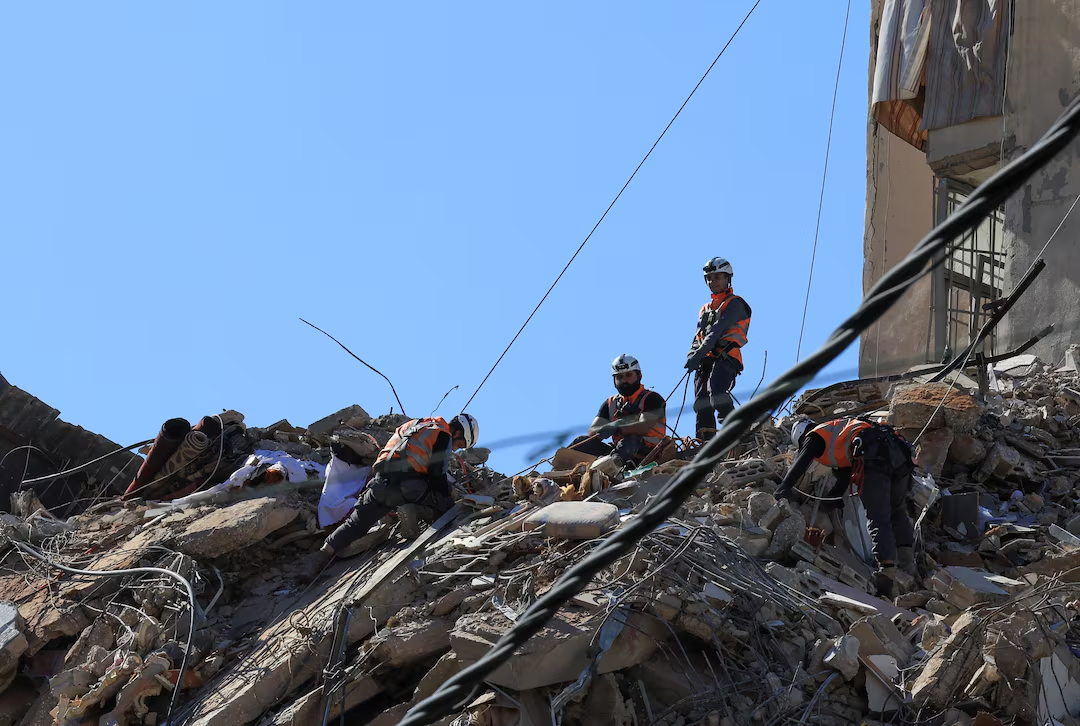
Rescue teams and emergency workers rushed to the scene shortly after the explosion. Images circulating online showed damaged buildings, shattered windows, and smoke rising above residential areas.
Families living near the targeted zone expressed fears that the region could once again descend into full-scale war.
Many residents remain traumatized by previous conflicts between Israel and Hezbollah, especially the devastating 2006 Lebanon war that destroyed major infrastructure and displaced thousands of civilians.
This latest attack has revived concerns that Lebanon could face another prolonged military confrontation at a time when the country is already struggling with severe economic and political crises.
Hezbollah’s Response Could Shape the Next Phase
At the time of reporting, Hezbollah had not officially confirmed whether the targeted commander was killed. However, regional observers expect the group to respond in some form.
Possible Hezbollah responses include:
- Rocket attacks into northern Israel
- Drone strikes against Israeli military positions
- Limited border skirmishes
- Expanded attacks targeting Israeli troops in disputed areas
Hezbollah faces a difficult balancing act. The organization wants to demonstrate strength without triggering a devastating full-scale war that Lebanon may not be able to withstand economically or politically.
Iran’s influence will also play a major role in determining Hezbollah’s next move.
Iran and the Wider Regional Picture
The timing of the strike is especially sensitive because the United States and Iran are reportedly moving closer toward a broader diplomatic agreement aimed at reducing regional conflict.
Iran had previously demanded an end to Israeli attacks in Lebanon as part of wider negotiations. The renewed strike on Beirut could complicate those discussions significantly.
Tehran has long supported Hezbollah financially and militarily. As a result, any escalation involving Hezbollah directly affects Iran’s regional strategy.
Analysts believe Iran may now face pressure from hardline factions demanding a stronger response to Israeli military actions.
At the same time, Washington continues working to prevent the conflict from spreading further across the Middle East.
Lebanon Rejects Immediate High-Level Talks
Lebanese Prime Minister Nawaf Salam stated that it remains too early for any high-level political meeting between Lebanon and Israel.
According to Salam, securing and strengthening the ceasefire must happen before broader negotiations can move forward.
Lebanon’s government has recently engaged in indirect discussions with Israeli representatives through U.S.-mediated diplomatic channels. These talks represent some of the highest-level contacts between the two countries in decades.
However, Hezbollah strongly opposes direct normalization with Israel.
Lebanese President Joseph Aoun also emphasized that security agreements and an end to Israeli attacks must come first before any political meetings can occur.
The differing positions inside Lebanon highlight deep political divisions between Hezbollah and other Lebanese factions seeking stability and diplomatic engagement.
Israel Expands Military Pressure in Southern Lebanon
Before the Beirut strike, Israel reportedly issued evacuation warnings for several villages north of the Litani River.
Observers say this could indicate plans for expanded military operations deeper inside Lebanon.
Israel has already established what it describes as a “security zone” extending several kilometers into southern Lebanon. Israeli officials argue the buffer zone is necessary to protect northern Israeli communities from Hezbollah attacks.
Critics, however, claim the expanded military presence risks violating Lebanese sovereignty and further destabilizing the region.
The growing military activity has raised fears that isolated strikes could evolve into sustained combat operations.
The United States Pushes for Stability
The United States has remained heavily involved in diplomatic efforts aimed at preventing a wider regional war.
Last month, U.S. President Donald Trump announced a temporary extension of the ceasefire agreement and expressed hope that Israel and Lebanon could eventually move toward a peace arrangement.
Washington has hosted meetings involving Lebanese and Israeli ambassadors, although those talks remain highly sensitive.
American officials continue urging restraint on all sides.
Diplomatic analysts believe the U.S. faces increasing pressure to preserve the ceasefire because renewed fighting could threaten broader negotiations involving Iran and regional security arrangements.
Read: Trump press dinner attack suspect update security concerns
Humanitarian Concerns Continue to Grow
Renewed violence between Israel and Hezbollah could create severe humanitarian consequences for civilians on both sides of the border.
Potential impacts include:
- Mass displacement of Lebanese civilians
- Damage to infrastructure
- Disruption of medical services
- Economic collapse in already struggling communities
- Increased regional refugee pressures
Lebanon’s healthcare and financial systems remain under enormous strain following years of economic crisis, political instability, and previous conflicts.
Aid organizations warn that another major war could overwhelm humanitarian resources across the country.
Global Reactions Expected After Israel Strikes Beirut
Several world governments are expected to respond diplomatically following the latest strike.
Countries including France, the United States, Turkey, and members of the European Union are likely to call for restraint and renewed negotiations.
The United Nations may also increase pressure for renewed ceasefire monitoring mechanisms along the Israel-Lebanon border.
International leaders fear that escalating violence could destabilize the entire Middle East at a time when multiple regional crises are already unfolding.
Military Experts Warn of Dangerous Escalation
Security analysts say the situation remains highly unpredictable.
Several factors increase the risk of escalation:
- Hezbollah retaliation pressure
- Iranian regional influence
- Israeli military objectives
- Political divisions inside Lebanon
- Ongoing border tensions
Military experts warn that even a limited retaliation could rapidly spiral into a broader confrontation.
Because Hezbollah possesses advanced rocket and drone capabilities, any sustained conflict would likely affect both Lebanese and Israeli civilian populations.
Can the Ceasefire Survive?
The biggest question now is whether the ceasefire agreement can survive this latest crisis.
Several possibilities remain:
Limited Escalation
Both sides exchange symbolic attacks while avoiding full-scale war.
Diplomatic Intervention
The United States and international mediators successfully pressure both parties back toward negotiations.
Full Conflict Resumes
Large-scale fighting returns across southern Lebanon and northern Israel.
Most regional analysts believe all parties still want to avoid a major war. However, repeated military incidents increase the possibility of miscalculation.
Political Divisions Inside Lebanon Deepen
The renewed violence also exposes growing divisions within Lebanon itself.
Some Lebanese political factions argue Hezbollah’s military operations place the country at unnecessary risk. Others believe Hezbollah remains essential for resisting Israeli military pressure.
The government now faces enormous challenges:
- Maintaining internal political stability
- Preventing economic collapse
- Managing international diplomatic pressure
- Addressing security concerns
- Avoiding civil unrest
Lebanon’s leadership must balance competing domestic and regional interests while attempting to prevent another devastating conflict.
Regional Security Remains Fragile
The Middle East continues experiencing heightened instability involving multiple interconnected conflicts.
Tensions involving Iran, Israel, Hezbollah, Syria, and Gaza remain deeply linked. Any escalation in one area can quickly affect neighboring regions.
The Beirut strike demonstrates how fragile current ceasefire arrangements remain.
International observers fear that without stronger diplomatic guarantees, temporary truces may continue collapsing under military and political pressure.
FAQ Section
What happened in Beirut?
Israel launched an airstrike on Beirut’s southern suburbs, targeting a Hezbollah commander for the first time since the recent ceasefire agreement.
Why did Israel strike Beirut?
Israeli officials said the strike targeted a commander from Hezbollah’s elite Radwan force, which Israel accuses of planning attacks against Israeli communities.
Is the Israel-Hezbollah ceasefire over?
The ceasefire has not officially ended, but the latest strike has placed the agreement under serious strain.
How has Lebanon responded?
Lebanese leaders condemned the attack and stated that meaningful talks with Israel cannot happen until attacks stop and security improves.
Could the conflict escalate further?
Yes. Analysts warn that Hezbollah retaliation or additional Israeli strikes could trigger wider regional conflict if diplomacy fails.

